Vertebroplasty Research studies

The abstracts of Vertebroplasty Research studies on this page are direct quotations from the National LIbrary of Medicine web site at Pub Med .

Research Studies Of Interest.

  1. This first study considered the effect of the procedure on patient pain and quality of life.

    "Does vertebral height restoration achieved at vertebroplasty matter?" by McKiernan F, Faciszewski T, Jensen R. of Center for Bone Diseases, Marshfield Clinic, 1000 North Oak, Marshfield, Wisconsin 54449, USA. J Vasc Interv Radiol. 2005 Jul;16(7):973-9.

    PURPOSE: Altered vertebral and spinal configuration after osteoporotic vertebral compression fracture (VCF) is believed to contribute to postfracture morbidity. The objective of this study was to determine whether patients in whom partial vertebral height restoration (VHR) was achieved at percutaneous vertebroplasty had greater pain relief or improved quality of life compared with patients in whom no anatomic restoration was achieved.

    MATERIALS AND METHODS: Consecutive subjects undergoing percutaneous vertebroplasty for painful osteoporotic VCFs completed the Osteoporosis Quality of Life Questionnaire (OQLQ) a validated, disease specific instrument that measures health related quality of life in women with osteoporosis with back pain caused by VCF. At postoperative week 2, month 2, and month 6, all subjects completed the mini-OQLQ, a validated extraction of OQLQ. Pain was rated with a standard visual analogue scale (VAS). Radiographs were manually digitized and evaluated for the presence of dynamic mobility and VHR. The relationship between VHR achieved at percutaneous vertebroplasty and postoperative pain relief and quality of life outcome was examined by multivariate analysis.

    RESULTS: Forty-six subjects (32 women) underwent 49 ...[the] procedures to treat 66 painful VCFs. Mean patient age was 74.3 years+/-10.9. Mean fracture age was 2.5 months+/-2.1. Pain rating fell from 7.7+/-1.8 to 2.8+/-1.8 within 1 day of percutaneous vertebroplasty and remained improved through month 6 (P<.001). All OQLQ domains improved substantially at week 2 (P<.02) and remained improved through month 6 (P

    CONCLUSION: Partial vertebral height restoration achieved at percutaneous vertebroplasty did not result in additional pain relief or improved quality of life beyond cement fixation alone.

  2. The second study reviewed patient records to learn if there were subsequent vertebral fractures in those who underwent the procedure.

    "New symptomatic vertebral compression fractures within a year following vertebroplasty in osteoporotic women." by Syed MI, Patel NA, Jan S, Harron MS, Morar K, Shaikh A. Department of Radiology, Mercy Medical Center, Springfield, OH 45501, USA.AJNR Am J Neuroradiol. 2005 Jun-Jul;26(6):1601-4.

    BACKGROUND AND PURPOSE: Percutaneous vertebroplasty has been performed in the United States in an increasing volume since the mid-1990s. The purpose of this study is to analyze the risk of a new symptomatic vertebral compression fractures within 1 year of having an acute/subacute fracture treated with vertebroplasty.

    METHODS: A retrospective analysis was performed in which 253 female patients were found to have acute/subacute vertebral compression fractures secondary to osteoporosis treated with percutaneous vertebroplasty. Occurrences of new symptomatic vertebral compression fractures were recorded for a year following initial vertebroplasty.

    RESULTS: Fifty-five patients (21.7%) of the 253 osteoporotic women with one or more initial fractures experienced a new symptomatic vertebral compression fracture within 1 year.

    CONCLUSION: Roughly one-fifth of osteoporotic women with acute/subacute fracture treated with vertebroplasty will have a subsequent fracture within 1 year.

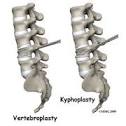
  3. This study compared the results of this procedure with those from Kyphoplsty, a surgical intervention for vertebral fracture.

    "Minimal invasive stabilization of osteoporotic vertebral fractures: a prospective nonrandomized comparison of vertebroplasty and balloon kyphoplasty." by Grohs JG, Matzner M, Trieb K, Krepler P. Department of Orthopaedic Surgery, Medical University Vienna, Wien, Austria. Spinal Disord Tech. 2005 Jun;18(3):238-42. OBJECTIVE: During recent years, the benefits of balloon kyphoplasty and vertebroplasty have been frequently discussed for the treatment of osteoporotic vertebral compression fractures. Because of the lack of comparative studies, we performed an investigation to describe the mechanical effects and the impact on life quality during a follow-up period of 2 years.

    METHODS: Patients with nonrecent fractures of vertebral bodies, ongoing bone remodeling, and major kyphotic deformity were treated with minimal invasive stabilization. The median duration of pain was 8 weeks before surgery. Because of the availability of the equipment, 28 patients were nonrandomly assigned to balloon kyphoplasty and 23 patients to vertebroplasty. The follow-up was performed 2 years after surgery.

    RESULTS: The kyphotic wedge of the vertebral bodies was decreased 6 degrees by balloon kyphoplasty but not by vertebroplasty. With both methods, we found a rapid decrease of pain down to one-half of the preoperative value. A long-lasting effect on pain was found only after balloon kyphoplasty. In the kyphoplasty group, a decrease of the Oswestry Disability Index (ODI) score was found during the first postoperative year. After 2 years, the ODI was not different from preoperative values in both groups.

    CONCLUSIONS: In nonrecent fractures, the reduction of the kyphotic wedge by balloon kyphoplasty was superior in decreasing pain persisting over a period of 2 years. The ability to improve disability after kyphoplasty was limited to 1 year. In nonrecent fractures, the consequences of age and osteoporosis seem to equalize the effects of the restored sagittal profile on disability but not on pain.

  4. The fourth study reviewed overall effects of the procedure: pain, qulaity of life, subsequent fracture etc.

    "Percutaneous vertebroplasty for osteoporotic vertebral compression fractures: experiences and prospective clinical outcome in 26 consecutive patients with 50 vertebral fractures". by Fessl R, Roemer FW, Bohndorf K. Klinik fur Diagnostische Radiologie und Neuroradiologie, Klinikum Augsburg. Rofo. 2005 Jun;177(6):884-92. PURPOSE: Prospective evaluation of vertebroplasty for osteoporotic compression fractures concerning pain reduction, demand of analgesics and quality of life.

    MATERIAL AND METHODS: In 26 consecutive patients, 50 vertebral fractures were treated by . . .[the procedure] under fluoroscopic (n = 44) or combined fluoroscopic/CT guidance (n = 6). Prospective follow-up was performed after 6 (for 50 vertebral fractures) and 12 months (for 27 vertebral fractures). Visual analogue scale (VAS) and numeric rating scale (NRS) was applied for the assessment of pain. Subjective quality of life and analgesics demand was documented semi-quantitatively.

    RESULTS: Mean interval from the beginning of pain symptoms to therapy was 8.5 weeks. Vertebroplasty was technically successful in all evaluated patients. Pain severity decreased from 10 (defined at baseline as initial pain score) to 2.8 after 6 months and 2.7 after 12 months. Subjective quality of life was reported as very well, well or improved in 92 % (n = 26 after 6 months) or 100 % (n = 13 after 12 months). No need for additional analgesic therapy was observed in 69.3 % (n = 26) after 6 months and 61.5 % (n = 13) after 12 months. Eight newly developed vertebral fractures were observed during follow-up, with 5 fractures directly adjacent to previously treated vertebrae. Leakage of polymethyl methacrylate (PMMA) into the intervertebral space or spinal canal was observed in 22 % and 20 % respectively (n = 50 vertebrae) . No neurologic deterioration or complications requiring surgery were observed.

    CONCLUSION: ... [It] is a successful therapeutic approach for the treatment of osteoporotic vertebral fractures. Persistent improvement of clinical symptoms was shown at follow-up after 6 and 12 months.


Go to Vertebroplasty page or use the Navigation bar on the left to find additional information about Osteopenia or Dowagers humps.